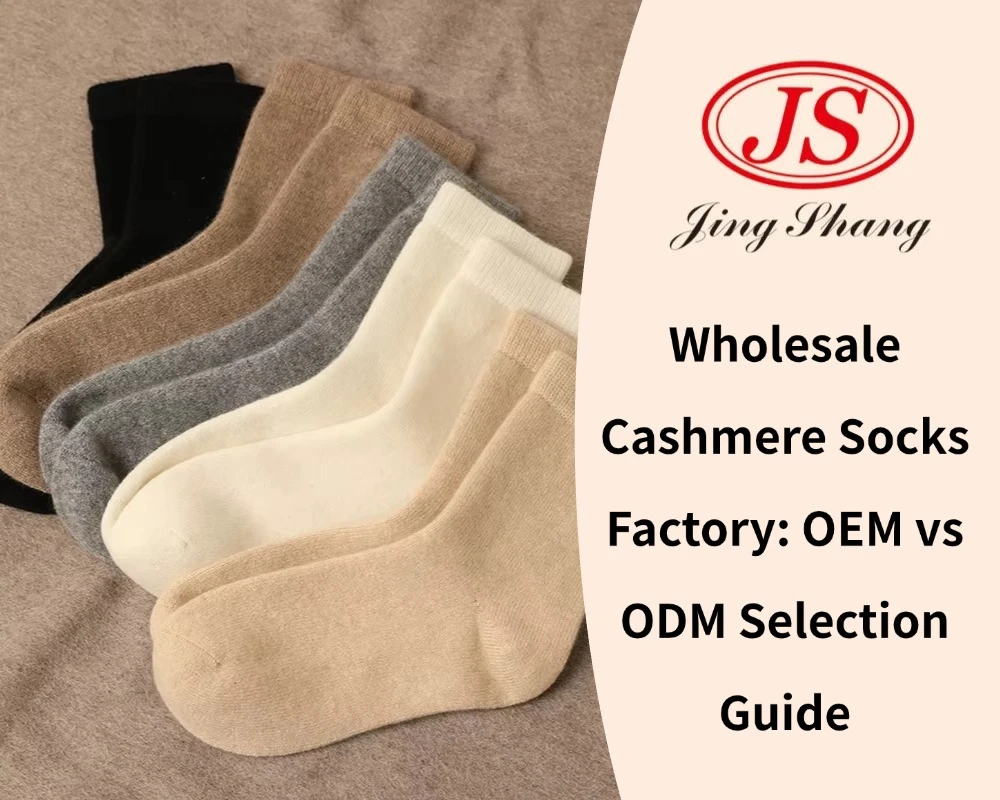
Wichtigste Erkenntnisse
- Model Matching: OEM is suitable for large buyers with mature design drawings who seek exclusive copyright and brand differentiation; ODM is suitable for emerging brands and small-to-medium wholesalers looking for rapid new arrivals and lower upfront R&D costs.
- Quality Identification: The core of high-quality cashmere socks lies in raw material fiber metrics (preferably sourced from Inner Mongolia, fineness within 15,5 μm, Länge über 38 mm) and needle-count anti-pilling craftsmanship (anti-pilling reaching Klasse 3-4).
- Cost Reduction & Pitfall Avoidance: A scientific blend ratio of 70% cashmere + 28% nylon + 2% spandex can enhance sock wear resistance and reduce costs by 15-20%, effectively avoiding excessive shrinkage rates and low-quality down imitation traps.
- Jingshang Manufacturing Edge: As a top cashmere manufacturer with a 33-jährige Geschichte, Jingshang relies on its 10.000 Quadratmeter factory and CE, SGS, Oeko-Tex und GRS certifications to provide full-dimensional custom guarantees from raw materials to styles.
When preparing to procure Großhandel Kaschmirsocken, many brand owners and procurement managers often hesitate between choosing OEM (Original Equipment Manufacturer) or ODM (Original Design Manufacturer) modes. Different procurement models directly determine product R&D cycles, upfront capital investment, minimum order quantities (MOQ), and subsequent brand premium spaces.
Als professioneller Kaschmirfabrik mit einem 33-jährige Geschichte, we will deeply analyze the selection logic of OEM and ODM from technical parameters, supply chain control, and production workflow perspectives in this guide, helping you make cost-effective procurement decisions.
Cashmere Socks OEM vs ODM Mode Analysis
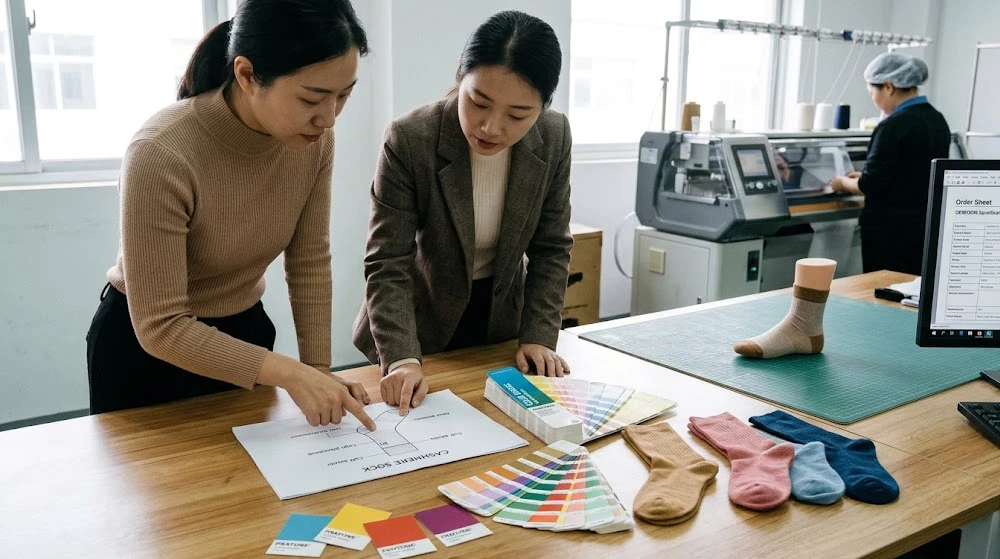
In the cashmere textile supply chain, when finding a suitable Kaschmirfabrik to cooperate with, buyers need to clarify the different operational paths of OEM and ODM. The OEM mode emphasizes “manufacturing according to drawings”, where buyers provide complete design drawings, needle count requirements, fabric component ratios, and Pantone color cards, and the factory is responsible for raw material procurement and manufacturing; the ODM mode is “solution output”, where the factory provides ready-made design samples, pattern libraries, and style recommendations, and buyers select them to directly private-label or fine-tune details for production. There are significant differences between the two in upfront development costs (Apt Cost) and supply chain response speed.
| Evaluation Dimension | OEM Mode (Contract Manufacturing) | ODM Mode (Design Private Labeling) |
| Design Ownership | Buyer fully owns intellectual property | Factory owns base patterns and design copyright |
| Sampling Cycle | 15-20 Tage (requires completely new mold making) | 3-5 Tage (fine-tuned based on existing patterns) |
| Mindestbestellmenge (MOQ) | Higher (usually over 500 pairs per color/style) | Lower (usually over 200 pairs per color/style) |
| Applicable Buyers | Mature brands, haute couture brands, professional retailers | Cross-border e-commerce, emerging brands, fast-turnover wholesalers |
According to data from the Global Textile Procurement Index industry report, when buyers order Großhandel Kaschmirsocken, the average R&D sampling cycle for choosing the OEM mode is 15-20 Tage, while the ODM mode can shorten the sample confirmation cycle to 3-5 Tage because the factory has ready-made pattern and design databases. For brands entering the cashmere sock sector for the first time, ODM can significantly reduce upfront design trial-and-error costs; for established buyers with mature product lines, OEM is an inevitable choice to safeguard product uniqueness and market isolation.
💡 Häufig gestellte Fragen
Q: What is the biggest difference between cashmere socks OEM and ODM?
A: The core difference lies in design copyright and sampling cycle. OEM requires buyers to provide design drawings, and the factory is responsible for precise production, making it suitable for creating exclusive high-end products; ODM requires the factory to provide mature design solutions for buyers to private-label and launch, with a sampling cycle of only 3-5 days, suitable for quick market entry.
Premium Cashmere Raw Materials and Craftsmanship Identification
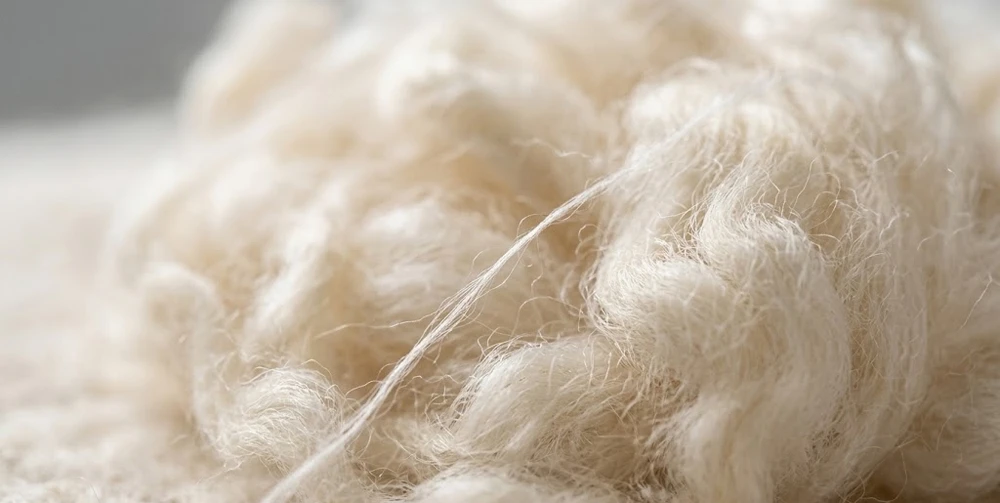
When any professional Kaschmirfabrik produces cashmere socks, the warmth, softness, and wear resistance of the products fundamentally depend on the physical metrics of raw materials and the precision of knitting equipment. According to the Sustainable Cashmere Association (SCA) raw material grading standard, top-tier cashmere prefers premium Inner Mongolia cashmere, with its average fiber fineness controlled within 15,5 μm and natural length reaching over 38 mm. The finer and longer the fibers, the stronger the cohesion during spinning, making the feel of garments or socks increasingly weich und warm, while being less prone to pilling.
- Faserfeinheit: Selected 15,5 μm or below Inner Mongolia raw down, high loftiness, ultimate skin-friendliness.
- Faserlänge: Reaching over 38 mm, significantly increasing tensile strength and wear resistance performance.
- Anti-Pilling Grade: Subjected to standardized washing and milling processes, with anti-pilling performance stabilized at Klasse 3-4.
- Needle Count Coverage: Unterstützt 96N-200N multiple needle count knitting, meeting four-season requirements for different scenarios.
In terms of knitting craftsmanship, producing high-quality Großhandel Kaschmirsocken typically utilizes computer knitting machines ranging from 96N to 200N (needle count) for weaving. For example, 96N-120N is suitable for extra-thick warm models, while 168N-200N is often used for fine-needle business lightweight models. Evaluating cashmere sock quality also hinges on water-washing milling processes and anti-pilling treatments; high-quality cashmere socks must undergo multiple eco-friendly auxiliary washings to maintain loftiness while elevating the anti-pilling grade to Klasse 3-4 under ISO 12945-2 standards, ensuring finished products maintain shape stability even after repeated wearing and washing.
💡 Häufig gestellte Fragen
Q: How to test the cashmere purity and quality of wholesale cashmere socks?
A: Comprehensive identification can be conducted via laboratory microscopic observation (testing fiber fineness ≤15.5μm), chemical dissolution method (verifying 100% cashmere purity), and anti-pilling testing (reaching Grade 3-4). Factories should be requested to issue authoritative test reports prior to procurement.
Cashmere Sock Procurement Pitfalls and Cost Control
When procuring Großhandel Kaschmirsocken in bulk, buyers often encounter low-price traps, such as using low-quality scrap/short down, disguising coarse wool as cashmere, or experiencing excessive bulk shrinkage rates due to inadequate washing and setting. The key to solving such problems lies in establishing a transparent raw material acceptance mechanism and a reasonable spinning blend formula. Purely pursuing 100% Kaschmir is not necessarily suitable for all sock scenarios, as natural cashmere fibers are relatively brittle and prone to friction wear at the heel and toe areas of socks.
- Trap 1: Inferior Short Down Substitution
- Countermeasure: Require the cooperating Kaschmirfabrik to present Raw Material Origin certificates and third-party fiber length test data.
- Trap 2: Severe Shrinkage and Deformation
- Countermeasure: Explicitly require bulk wash shrinkage rates to be controlled within ±3% in procurement contracts.
- Trap 3: Poor Wear Resistance Leading to High Return Rates
- Countermeasure: For daily sock items, prioritize heel/toe reinforcement craftsmanship or choose cost-effective blend ratios.
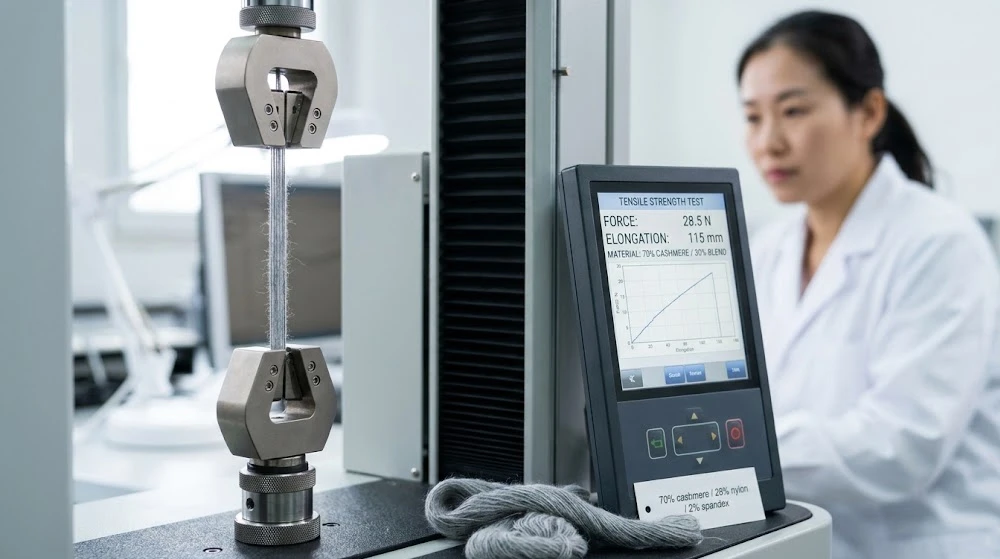
By introducing a reasonable blend ratio, the natural soft and warm attributes of cashmere can be retained while significantly elevating sock durability. Laboratory test data indicates that adopting a scientific blend structure of 70% cashmere + 28% nylon + 2% spandex can maintain over 85% of original warmth experiences while increasing sock wear tear strength by 200% and reducing single-pair procurement costs by 15-20%, making it the most popular cost-effective blending formula in the global B2B market currently.
💡 Häufig gestellte Fragen
Q: How to balance warmth and wear resistance costs when purchasing cashmere socks in bulk?
A: A scientific blend solution of 70% cashmere + 28% nylon + 2% spandex is recommended. This structure not only retains the warm and soft characteristics of cashmere, but also significantly enhances heel and toe wear resistance, reducing procurement costs by 15-20%.
33-Year Manufacturing Heritage and Scaled Production Capacity
Als professioneller Kaschmirfabrik mit einem 33-jährige Geschichte, Jingshang has accumulated extensive production experience in cashmere textiles and sock manufacturing. We deeply understand global buyers’ core demands for product delivery timeliness, quality stability, and cost control, consistently adhering to controlling raw material quality from the source. The company’s core raw material procurement base in Inner Mongolia ensures that every batch of raw materials utilizes premium Inner Mongolia cashmere.
- 33-Year Industry Heritage: Focusing on deep processing of cashmere products, well-versed in quality standards across different global regional markets.
- 10,000㎡ Modern Plant: Standard industrial park, possessing scaled bulk order undertaking and warehouse turnover capabilities.
- 80 Professional Machines & 100+ Staff: Equipped with automated knitting and setting equipment, ensuring bulk ex-factory qualification rates reach over 99.5%.
- Premium Source Cashmere from Inner Mongolia: Directly connected to premium pastures, guaranteeing raw material purity and natural weich und warm performance.
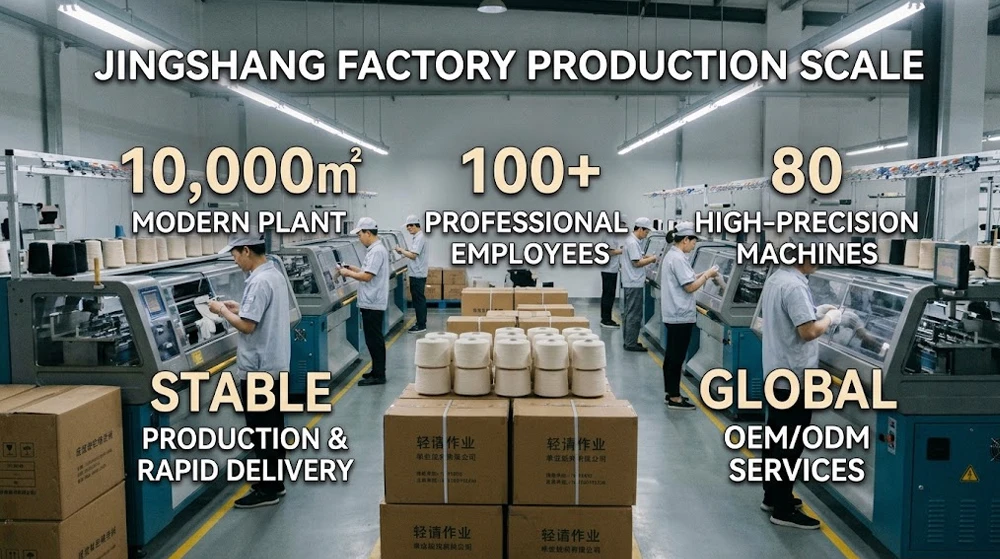
We have established a full-process quality traceability system in production links, where every process—from raw down carding, spinning, knitting weaving to finishing washing and packaging—is precisely regulated by experienced textile technicians. Jingshang possesses a 10.000 Quadratmeter große Fabrikproduktionsfläche, equipped with over 100 staff members Und 80 Maschinen (including imported computerized single/double cylinder sock machines and automated toe-linking washing setting equipment). Scaled production capacity enables us to guarantee efficient delivery for large-batch Großhandel Kaschmirsocken orders, effectively helping clients avoid out-of-stock risks during peak sales seasons.
💡 Häufig gestellte Fragen
Q: What is the production scale and daily capacity of Jingshang factory?
A: Jingshang possesses a 10,000-square-meter factory production area, over 100 professional employees, and 80 high-precision machines, with stable production and rapid delivery capabilities for large-batch OEM/ODM orders.
International Certifications and Full-Dimensional Custom Services
To help global buyers successfully expand into high-end retail markets in Europe, America, and the Asia-Pacific region, Jingshang, as a reliable Kaschmirfabrik in the industry, has established a complete quality management and environmental compliance certification system. The factory has passed multiple authoritative certifications including CE, SGS, Oeko-Tex Standard 100 und GRS (Global Recycled Standard), with products fully conforming to strict international market requirements regarding textile chemical safety and eco-sustainability.
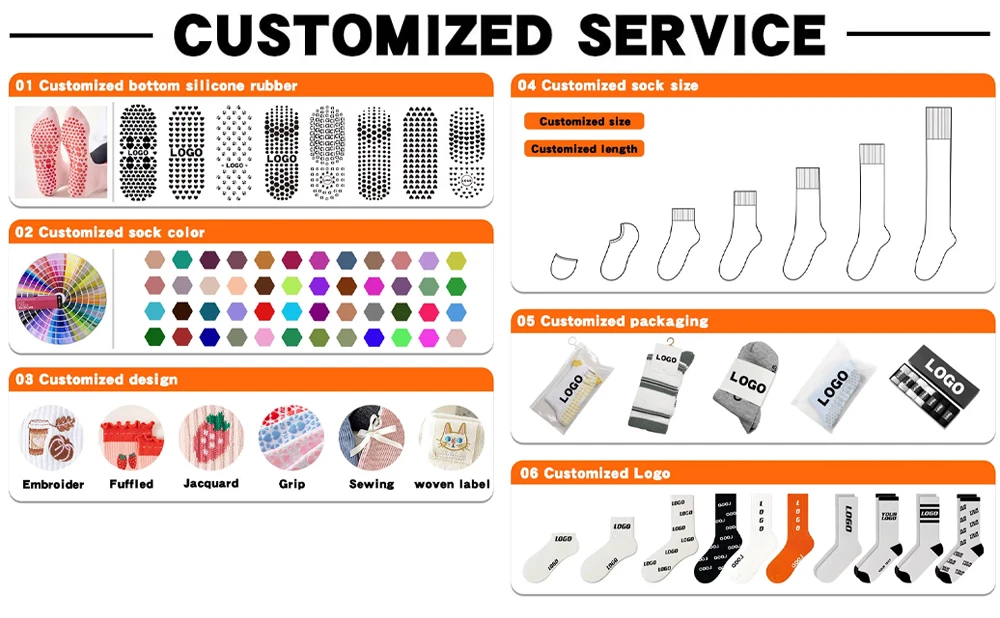
- Materialanpassung: Unterstützt 100% Kaschmir and various cashmere blend ratios (such as cashmere + cotton, cashmere + silk, etc.).
- Logos and Patterns: Supports precise embroidery, jacquard, printing, and custom care labels/hangtags.
- Colors and Styles: Precise dyeing according to Pantone color codes, supporting development of crew socks, boat socks, captain socks, and extra-thick sleep socks.
- International Certification Guarantees: Hält CE, SGS, Oeko-Tex und GRS authoritative testing and factory audit certificates, ensuring seamless global customs clearance.
We provide clients with full-dimensional custom services covering Materialien, Logos, Muster, Farben und Stile. Im Service-Workflow setzt Jingshang ein dediziertes Projektmanager-Verantwortlichkeitssystem ein, das während des gesamten Prozesses visuelles Feedback zu den einzelnen Knotenpunkten bietet – von der anfänglichen Farbabstimmung (mit einer Genauigkeit der Pantone-Kartenabstimmung von über …) 98%), von der Logo-Jacquard-/Stickerei-Mustererstellung über die Bestätigung des Vorproduktionsmusters in der Zwischenphase bis hin zur Verpackung per See-/Luftfracht in der Endphase. Unser Großhandel Kaschmirsocken Produkte kombinieren umweltfreundlich, weich und warm Vorteile, die Käufern helfen, eine nahtlose Markenumsetzung im geschlossenen Regelkreis zu erreichen.
💡 Häufig gestellte Fragen
F: Welche Zolldienstleistungen und internationalen Exportzertifizierungen bietet Jingshang an?
A: Jingshang unterstützt die vollständige Anpassung von Materialien (100% Kaschmir/Mischgewebe), Logos, Mustern, Farben und Stilen und hat international anerkannte Zertifizierungen wie CE, SGS, Oeko-Tex und GRS erhalten, um die Einhaltung der Exportbestimmungen vollständig zu gewährleisten.
Suchen Sie einen zuverlässigen Großhändler für Kaschmirsocken? Kontaktieren Sie Jingshang noch heute für kostenlose Muster und ein individuelles Angebot!
| Jetzt anfragen | E-Mail:info@hwcashmere.com | WhatsApp:+8613932982033 |
Die Wahl des passenden OEM- oder ODM-Modells ist für Inhaber und Käufer von Kaschmirsockenmarken der entscheidende erste Schritt zum kommerziellen Erfolg. 33 Jahre Geschichte in technischer Expertise, starke Produktionskapazität von einem 10.000 Quadratmeter große Fabrikproduktionsfläche, ausgewählt premium Inner Mongolia cashmere Rohstoffe und ein vollständiges Set internationaler Qualifikationszertifizierungen – Jingshang zählt zu den weltweit führenden Unternehmen. Kaschmirfabrik, Wir werden Ihnen kontinuierlich qualitativ hochwertige und wettbewerbsfähige Produkte und Dienstleistungen anbieten. Großhandel Kaschmirsocken Fertigungsdienstleistungen. Kontaktieren Sie jederzeit unser professionelles Team, um gemeinsam eine effiziente, kundenspezifische Beschaffungslösung zu entwickeln.