Key Takeaways
- Set the Route Before Comparing Prices: Lock in ready stock, branded stock, modified styles, or original development first. Different paths have completely different MOQ and quotation logic.
- Written Brief Locks In Metrics: Specify material ratio, yarn count, weave/knit structure, dimensions with fringes, net weight tolerance, color codes, branding, and warehouse dates.
- Approve Coded Samples in Stages: Confirm materials, construction, development, and packaging samples before mass production. Assign unique codes and never approve via screen viewing.
- Calculate MOQ by Component Breakdown: Minimum order quantity is determined jointly by base fabric, dyeing, embroidery/jacquard, care labels, and gift box thresholds.
- Rely on a Mature Factory: Partnering with a cashmere scarf supplier with 33 years of experience, 10,000㎡ facility, 80 machines, and CE, SGS, Oeko-Tex, GRS certs ensures reliable delivery.
Buyers researching how to efficiently order custom cashmere scarves should follow a clear closed-loop process: select a sourcing path, calculate quotes, confirm materials and construction, conduct staged sampling, sign written confirmations, run mass production, perform inspections, pack compliantly, ship on schedule, and archive reorder files. Never focus solely on unit price comparisons at the start of a project.
Custom cashmere scarves refer to woven or knitted scarves where the buyer controls specifications like colors, dimensions, structures, embroidery, jacquard, printing, labels, or packaging. Choosing an experienced cashmere scarf supplier helps balance customization with MOQ, while enforcing the factory floor rule of “unified product identification” across specs, quotes, coded samples, and packing lists.
Custom Cashmere Scarf Sourcing Paths
Before sending inquiries to factories, buyers must clarify the specific sourcing path for custom cashmere scarves, as adding labels to existing stock differs completely from original development. The chosen path directly determines fixed parameters, resampling components, and final MOQ restrictions.
Depending on budgets, lead times, and brand differentiation needs, buyers can match and lock in from the following five mainstream sourcing paths:
- Existing Stock Sourcing: Best when stock colors and material lots fit without changes. Confirm exact SKUs, available quantities, composition certificates, dimensions, weight, lot consistency, allocation cutoffs, and reorder basis.
- Branded Stock Scarves: Add embroidered logos, main labels, care labels, hangtags, or boxes to established base styles. Confirm base scarf inventory alongside component MOQs, sampling fees, setup fees, and unused stock ownership.
- Modifications to Established Styles: Adjust colors, dimensions, hems, fringes, labels, or packaging on existing factory structures. List standard versus buyer-controlled fields in writing and approve coded modified samples.
- Original Product Development: Control yarn ratios, structures, dimensions, weight, exclusive colors, patterns, and packaging from scratch. Plan yarn and color trials, machine setups, staged samples, testing, and tolerances before comparing prices.
- Reorders of Historical Orders: Retrieve previously approved sample codes, spec revisions, controlled changes, and remaining accessory statuses. Verify retained reference numbers instead of ordering solely from old invoices.
Only after locking in the sourcing path and closing corresponding confirmation fields do quotations from each cashmere scarf supplier become horizontally comparable. This upfront decision isolates inventory lot confusion, accessory MOQ inversions, and development delays.
💡 Frequently Asked Questions
Q: What are the sourcing paths for custom cashmere scarves, and how should buyers choose before placing an order?
A: There are five main paths: ready stock, branded stock, modified styles, original development, and historical replenishment. Choose stock or add-on branding for fast turnaround, or modified and original routes for brand exclusivity, locking in paths before inquiring.
Specification Briefs and MOQ Control
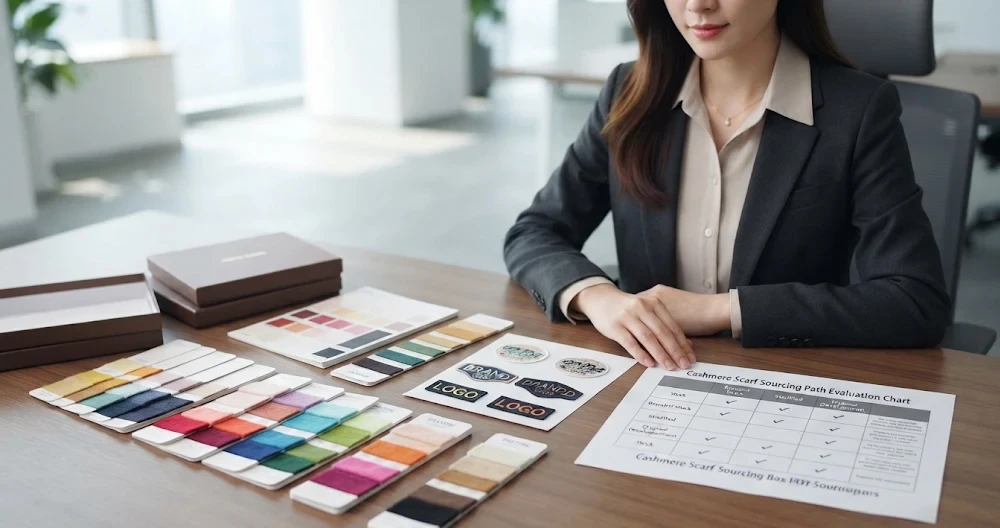
A professional specification brief translates creative concepts into an engineering language executed by sampling, production, QC, and packaging teams. Reference images cannot replace written definitions of materials, construction, dimensions, colors, and tolerances, while the MOQ of a cashmere scarf supplier is governed by the highest-threshold link in the brief.
To ensure accurate quotations and ambiguity-free production, buyers must implement the following core elements item by item when drafting briefs and calculating MOQs:
- Application and Delivery Framework: Clarify retail, wholesale, uniform, hotel, or gift use, specifying target markets, channels, seasons, launch dates, and warehouse deadlines to define labeling and packaging standards.
- Material and Fiber Metrics: Specify exact fiber percentages (100% cashmere or blends), substitutes, yarn counts, plies, and performance tests like colorfastness or pilling, plus testing stages for fineness, length, or coarse hair.
- Woven and Knitted Specifications: Lock in warp and weft counts, plies, weaves, fringes, and brushed finishes for woven styles, or yarn counts, gauges, stitches, and linking for knitted styles, avoiding “same as sample” descriptions.
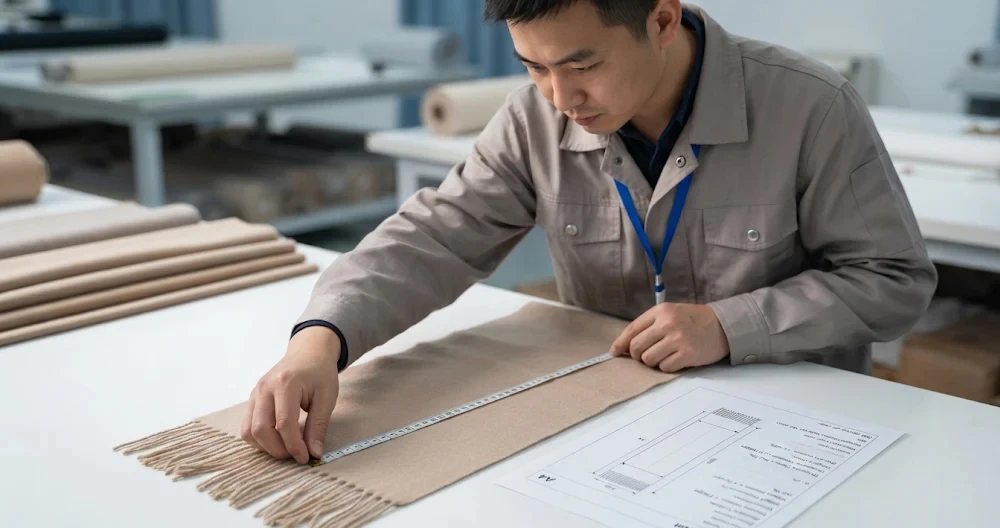
- Dimensions and Weight Tolerances: Define flat measurement points, length by width (cm), fringe inclusion, net weight excluding packaging (g), and mutually agreed allowable deviation ranges.
- Branding and Packaging Details: Itemize materials, sizes, artwork revisions, languages, and placement for main labels, care labels, hangtags, barcodes, bags, gift boxes, and carton marks, clarifying included versus extra charges.
- Component-Level MOQ Breakdown: List separate MOQs for base fabric, single-color dyeing, plate-making, labels, hangtags, and boxes. Distinguish total versus per-color quantities, define leftover material disposal, and verify “no MOQ” scopes.
Breaking abstract concepts into measurable parameters and reducing MOQs to component thresholds prevents hidden price hikes on custom cashmere scarves. With a clearly bounded brief, both parties can accurately calculate costs and production schedules.
💡 Frequently Asked Questions
Q: What factors determine the minimum order quantity for custom cashmere scarves?
A: MOQ is not a single number; it is controlled by base fabric stock, yarn preparation, custom dye vat capacities, machine setup, jacquard and embroidery plates, and label or box thresholds. Buyers should request component-level MOQ breakdowns by style and color.
Sampling Approval and Color Process Management
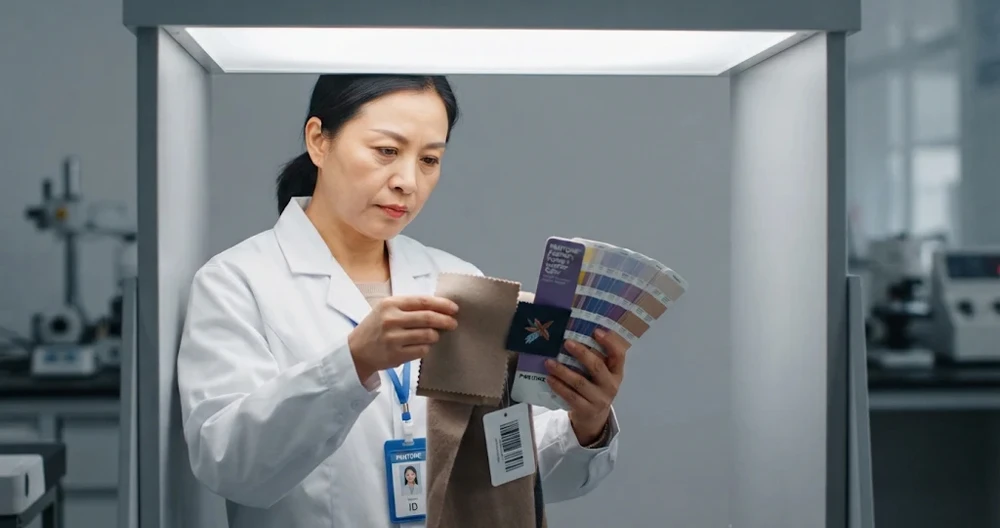
A standardized sample approval process for custom cashmere scarves prevents color deviations, mismatched hand-feel, or deformed logos in bulk production. Buyers should advance staged sampling according to customization depth, sign off at each node, and seal a uniquely coded “pre-production final reference sample.”
Focusing on color reproduction, brand logo craftsmanship, and staged sample sign-offs, buyers and factories should strictly enforce the following five core control specifications:
- Four-Step Physical Color Approval: Never approve colors on screens. Review physical swatches or Pantone codes under standard light boxes via Lab Dips, verify finished brushed structural swatches, and set dye-lot isolation rules.
- Embroidery File Locking: Confirm vector artwork, digitizing file versions, finished dimensions, placement, thread color codes, backing materials, front and back neatness, and allowable puckering ranges in writing.
- Jacquard and Printing Verification: Confirm pattern repeat sequences, colored yarn allocation, and front and back effects for jacquard, or repeat positioning, printing routes, penetration, softness, and colorfastness for printing.
- Five-Stage Sampling Loop: Progress through yarn confirmation, construction swatches, full-size development sample measurements, branding and packaging verification, and final pre-production reference sample coding and sealing.
- Eight-Module Approval Records: Record ID codes and approvers, material lot proof, structural dimensions and weight, color light sources and tolerances, file versions, packaging specs, measurement points, and open items with deadlines.
Every sample confirmation locks in legal and engineering benchmarks, preventing verbal compromises from turning into bulk losses. Solidifying colors, processes, and tolerances into sealed reference samples ensures precise replication by your cashmere scarf supplier.
💡 Frequently Asked Questions
Q: What samples and color standards need to be confirmed before mass production?
A: Confirm yarn materials, Lab Dips, construction swatches, full-size development samples, and packaging samples in stages, sealing a coded pre-production reference sample. Verify colors physically under standard light sources on actual finished structures, never via screens.
Quality Inspection Standards, Lead Times, and Compliant Labeling
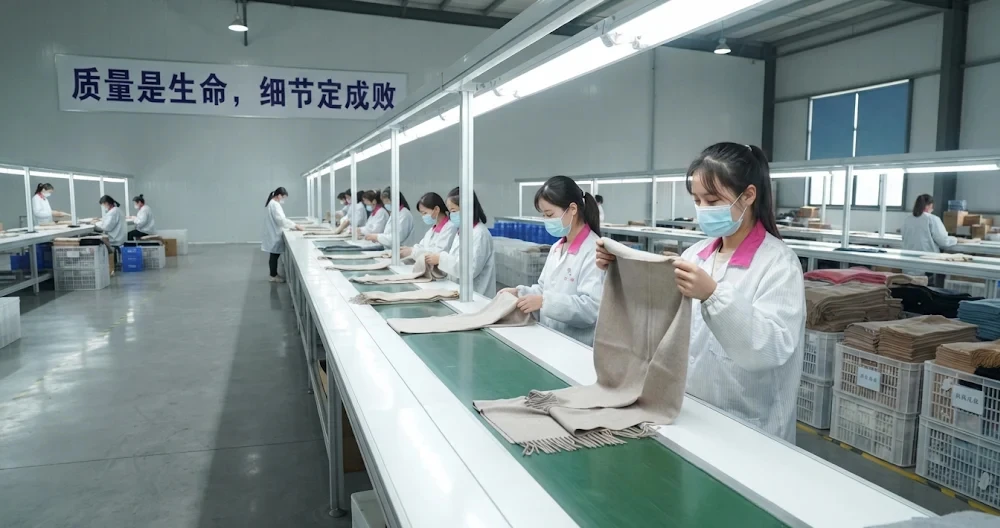
When bulk production nears completion, a rigorous QC system from your cashmere scarf supplier, transparent lead time management, and compliant market labeling ensure smooth warehousing and retail launch. Bulk inspection must follow a written sampling plan comparing goods item by item against sealed coded samples and specs.
To ensure zero-defect bulk quality, on-time international logistics, and smooth customs clearance at destination ports, end-to-end delivery control requires implementing the following six key actions:
- Six-Dimensional Bulk Inspection: Verify order and lot traceability, flat dimensions and net weight tolerances, workmanship defects (holes, pulls, stains, shading, loose fringes), label and barcode accuracy, lab test reports, and rework or rejection rules.
- Incoterms 2020 Liability Definition: Cite specific Incoterms 2020 rules (FOB, CIF, DDP), named places, and versions in POs to divide freight, documentation, insurance, and duty responsibilities, avoiding vague “freight included” terms.
- Backward Critical Path Scheduling: Schedule backward from target warehouse dates across customs, freight, final inspection, bulk production, and approvals. Never start bulk production while parameters remain open unless waived in writing.
- US and EU Labeling Compliance: Follow US FTC Cashmere Guidelines for fiber percentages, origin, and business identity, and Regulation (EU) No 1007/2011 for official-language fiber labeling, matching online descriptions to physical labels.
- Avoiding Eight Rework Traps: Avoid quoting before setting paths, substituting hand-feel for lab tests, trusting unquantified “Grade A” claims, omitting fringe length rules, screen-approving art, single-number MOQs, and uncoded samples.
- Standardized RFQ and Archiving: Use a six-item checklist (product, materials, color quantities, branding, testing, logistics) for initial RFQs, and archive complete technical files and leftover materials post-delivery for consistent reorders.
Quantifying quality acceptance, formalizing trade responsibilities, and front-loading regulatory labeling help avoid customs detentions and returns on custom cashmere scarves. Archiving standardized supply chain assets also makes every seasonal repeat order faster and more reliable.
💡 Frequently Asked Questions
Q: What should be focused on during bulk quality inspection and lead time control for custom cashmere scarves?
A: Inspect lot traceability, dimensional and weight tolerances, defects, US FTC and EU 1007/2011 label compliance, and test reports against coded samples under a written plan. Schedule lead times backward from warehouse arrival dates using explicit Incoterms 2020 rules.
Jingshang Customization Core Advantages
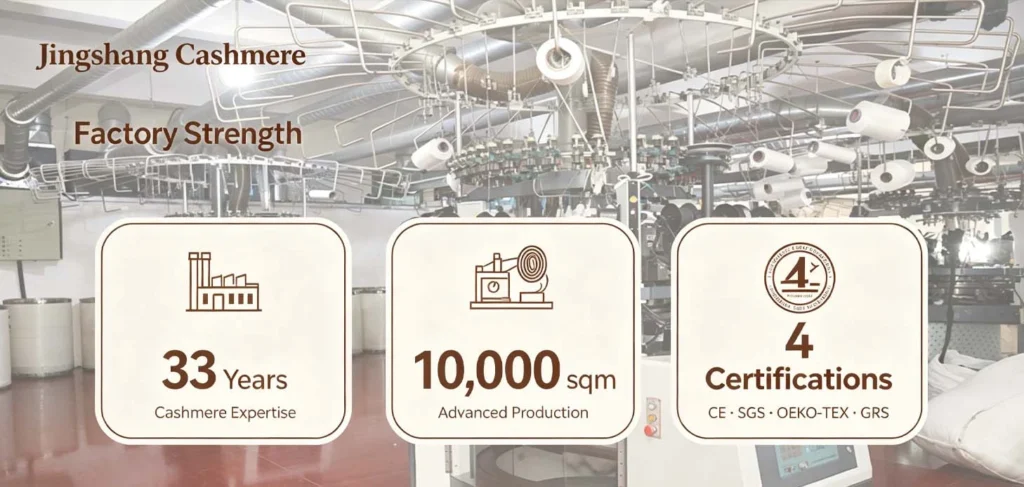
Choosing a cashmere scarf supplier combining historical heritage, hardware scale, and strict QC enables efficient execution from sampling to mass production. Rooted in cashmere manufacturing for 33 years, Jingshang specializes in producing custom cashmere scarves for global brands, retailers, wholesalers, and corporate projects.
Relying on solid industrial chain foundations and an international standard management system, Jingshang provides global buyers with the following four core competitive advantages:
- 33 Years of Manufacturing Heritage: Possessing 33 years of scarf production and export experience, well-versed in global quality preferences and tolerance controls to help buyers avoid craftsmanship and MOQ traps early on.
- Inner Mongolia Raw Materials: Selecting premium raw cashmere from Inner Mongolia across 100% cashmere and cashmere blends, delivering eco-friendly, ultra-soft, and lightweight warm wearing performance.
- 10,000㎡ Facility and Equipment: Operating a 10,000 square meter modern production facility with 80 specialized machines and over 100 experienced technicians, supporting both high-volume wholesale and flexible custom schedules.
- Full Customization and Certifications: Offering one-stop customization across materials, logos, patterns, colors, and styles with coded sample archiving, backed by CE, SGS, Oeko-Tex, and GRS international certifications.
Translating supply chain standards into reliable commercial delivery requires strong factory hardware. Jingshang combines transparent communication, controllable MOQs, and full-process QC to turn design blueprints into high-reputation products.
💡 Frequently Asked Questions
Q: What are the core advantages of choosing Jingshang for custom cashmere scarves?
A: Jingshang offers 33 years of experience, a 10,000㎡ facility, 100+ staff, and 80 machines. We use premium Inner Mongolia cashmere for 100% cashmere and blended scarves, providing full customization, eco-friendly softness, and CE, SGS, Oeko-Tex, and GRS certs.
Ready to launch your next cashmere scarf project? Send your specification brief, color-split quantities, target market, and warehouse arrival date to Jingshang today for prompt component-level quotes, sampling schedules, and custom solutions.
| Inquiry Now | Email:info@hwcashmere.com | Whatsapp:+8613932982033 |
Creating best-selling custom cashmere scarves with zero rework requires turning creative ideas into measurable, traceable documents. From locking in sourcing paths and component MOQs to enforcing coded sample approvals, quantified QC, and compliant labeling, rigorous control protects brand reputation and margins. Partnering with a reliable cashmere scarf supplier like Jingshang, backed by 33 years of experience and full certifications, ensures superior quality and on-time delivery.