Key Takeaways
- Factory Heritage & Support: Jingshang brings 33 years of manufacturing expertise, a 10,000 sqm facility, and flexible custom orders starting at just 50 pieces.
- Flexible Sourcing: Choose between OEM custom manufacturing and stock yarn customization depending on lead times and budget constraints.
- Crafting Precision: Understand the distinct benefits of woven versus knitted cashmere scarves to suit market preferences.
- Flawless Quality Control: Mitigate edge fraying risks through advanced selvedge weaving, AQL 1.5 testing, and strict post-processing protocols.
- Full Certification: Ensure material transparency with certified 100% Inner Mongolian cashmere backed by CE, SGS, Oeko-Tex, and GRS credentials.
Sourcing high-end luxury textiles requires working with trusted cashmere scarf manufacturers who understand precision, material integrity, and international quality standards. Whether you are launching a private label collection or scaling a luxury brand, placing an order for a custom cashmere scarf can feel complex without the right technical roadmap.
Buyers often face hurdles including rigid minimum order requirements, inconsistent sample hand-feels, and costly defect rates during bulk production. Finding a reliable supplier for a wholesale cashmere scarf line means securing non-stop quality from raw fiber processing down to final packaging. In this comprehensive guide, we unpack the complete procurement process—from selecting manufacturing models and fabric structures to negotiating MOQs, approving pre-production samples, and enforcing strict quality control against common edge fraying defects.
Best Custom Cashmere Scarf Sourcing Routes
Navigating the procurement process for high-end luxury scarves requires a clear understanding of the two primary manufacturing paths available in the textile industry. B2B buyers can choose between rapid stock-yarn customization and full original equipment manufacturing, depending on their specific project timeline, budget parameters, and initial order volume.
Selecting the right production channel directly impacts your brand’s market agility and profit margins:
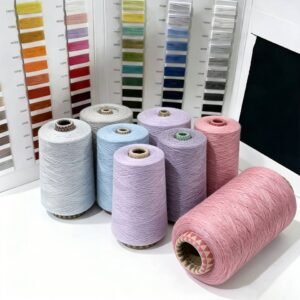
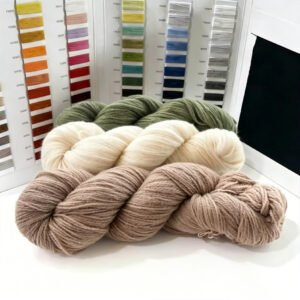
- Stock-Yarn Customization (ODM Route): This pathway utilizes pre-dyed, high-count pure cashmere yarns already maintained in factory inventory. It enables buyers to quickly apply custom brand tags, private woven labels, custom embroidery, and bespoke retail packaging with rapid turnaround times of 15 to 20 days.
- Full OEM Customization (Bespoke Route): Designed for established fashion labels requiring unique colorways, exclusive weave patterns, custom yarn blends, or specific dimensional specifications. Raw Inner Mongolian cashmere fiber is dyed directly to exact Pantone TCX or TPX codes, spun into target yarn counts, and woven from scratch over 30 to 45 days.
By carefully evaluating these options, procurement managers can optimize cash flow while maintaining premium product standards. Choosing stock-yarn programs provides a low-risk testing ground for new seasonal designs, whereas full OEM production delivers complete product exclusivity for established retail lines.
💡 Frequently Asked Questions
Q: What is the most cost-effective way to order custom cashmere scarves?
A: Utilizing stock-yarn customization is the most cost-effective approach for lower quantities. It eliminates custom fiber dyeing fees and significantly shortens production lead times from 45 days down to under 20 days.
Woven Cashmere Scarf vs Knitted Scarf
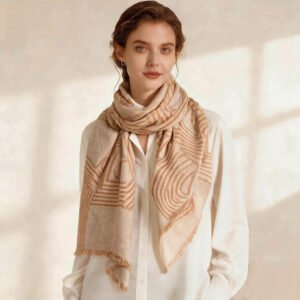
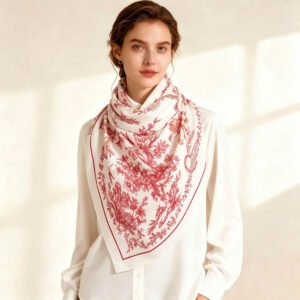
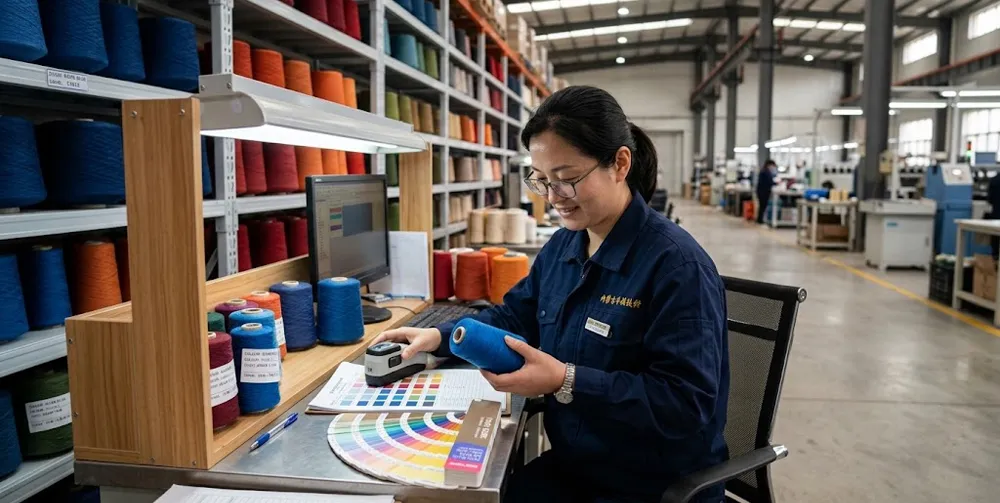
Choosing between a woven fabric structure and a knitted construction fundamentally alters the drape, surface texture, weight, and overall aesthetic of your finished scarf collection. Each manufacturing methodology delivers unique functional advantages tailored to specific market segments and consumer style preferences.
The matrix below highlights the core technical differences between woven and knitted cashmere constructions:
| Feature / Property | Woven Cashmere Scarves | Knitted Cashmere Scarves |
| Manufacturing Process | Interlocking warp and weft yarns on high-speed looms | Interlooping continuous yarn feeds on flat knitting machines |
| Fabric Structure | Rigid, dimensionally stable, smooth finish | Elastic, flexible, soft, three-dimensional texture |
| Edge Finish | Fringe end-finishing or traditional hand-rolled selvedge | Ribbed borders, tubular hems, or bound edges |
| Weight Range | Ultra-lightweight (100g) to heavy brushed (260g+) | Medium (180g) to heavy chunky knits (350g+) |
| Best Market Use | Formal wear, classic tartan, corporate gifts, suiting | Casual fashion, winter streetwear, cozy lounge lines |
Understanding these structural characteristics allows buyers to position their products effectively within the market. Woven cashmere scarves excel in traditional formal collections requiring sharp geometric patterns or brushed finishes, while knitted scarves offer unmatched elasticity, casual comfort, and rich visual textures ideal for contemporary lifestyle lines.
💡 Frequently Asked Questions
Q: What is the main structural difference between woven and knitted cashmere scarves?
A: Woven cashmere scarves use intersecting warp and weft yarns to create a stable, smooth fabric ideal for tailored looks, while knitted scarves use interlooping yarns that deliver higher elasticity, casual texture, and enhanced warmth.
Sampling Sign-off and Edge Fraying Control
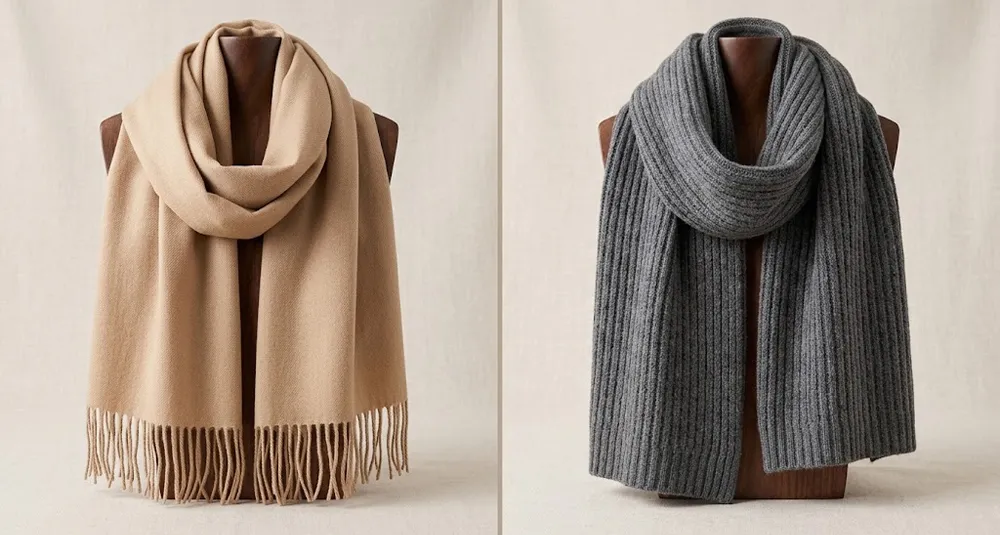
Transforming a digital design file into a market-ready custom cashmere scarf requires rigorous pre-production sampling and targeted edge craftsmanship. Controlling the development phase eliminates design misinterpretations before commercial looms are configured for bulk production.
A successful product development cycle relies on executing key sampling and finishing controls:
- Color & Prototype Matching: Lab dips are dyed to specified Pantone TCX/TPX codes and verified under D65 standard light boxes to maintain color variance at Delta E < 1.0. Proto samples verify fabric weight (GSM), brushing softness, and dimension.
- Pre-Production Sample (PPS) Sign-off: A fully decorated physical scarf—complete with private woven labels, wash care tags, and custom retail packaging—is approved as the final reference standard for mass assembly.
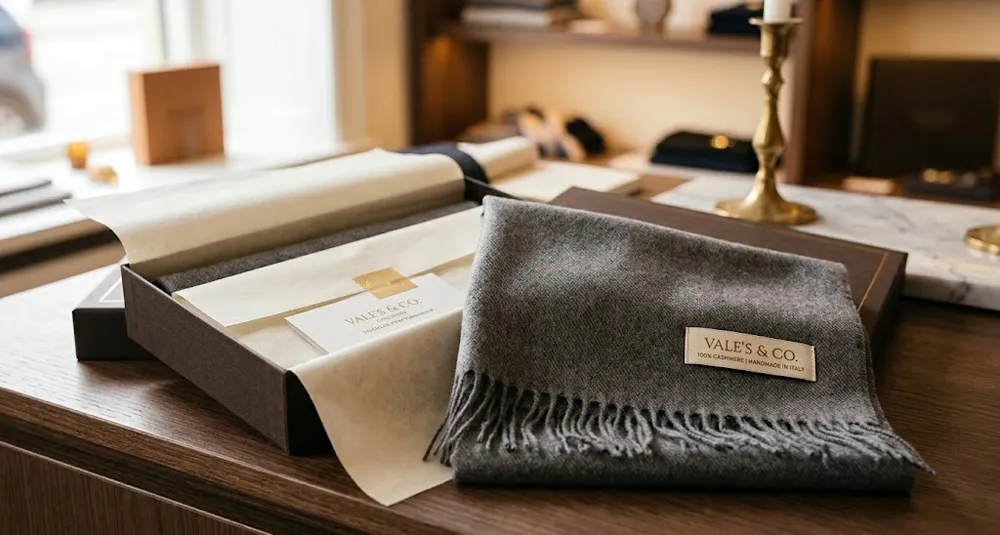
- Preventing Edge Fraying: Loose yarns along selvedges are secured using high-density lock-stitching, precision shuttleless loom warp tension control, or mechanical twisted fringe-knotting to protect edges against unraveling during wear.
Focusing on meticulous sample approval ensures your custom scarf collection translates brand aesthetics perfectly. By locking in edge stability and structural integrity during the prototyping stage, buyers eliminate the primary cause of customer returns and product complaints.
💡 Frequently Asked Questions
Q: How do experienced factories prevent edge fraying on bulk cashmere scarves?
A: Factories prevent edge fraying by using high-density lock-stitch hem margins, reinforced selvedge weaving, mechanical fringe-knotting techniques, and strict edge tension testing prior to packaging.
Bulk Production Timelines and Quality Assurance
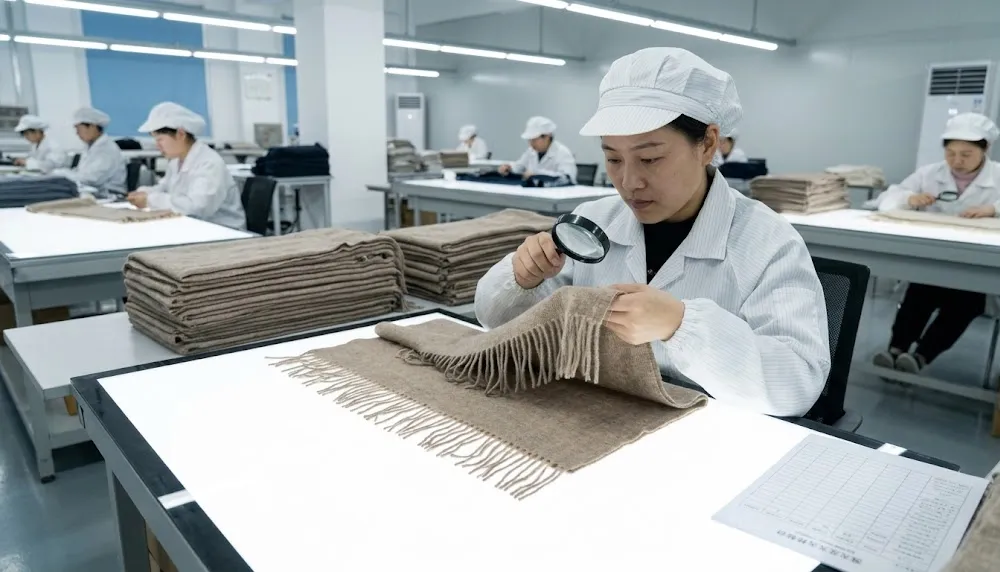
Managing a wholesale cashmere scarf order requires strict adherence to production schedules and systematic multi-stage quality audits. Establishing clear production milestones ensures on-time delivery for seasonal retail campaigns while keeping defect rates well below industry averages.
A structured manufacturing schedule incorporates systematic quality checks across three distinct phases:
- Raw Material Verification: Inspecting incoming Inner Mongolian cashmere fiber to confirm staple lengths exceeding 34mm and fiber fineness under 15.5μm before yarn spinning begins.
- Inline Weaving & Finishing Audits: Monitoring yarn tension, weight consistency (±3% GSM), and color fastness to rubbing and washing (ISO 105 Grade 4-5) during active weaving and surface brushing.
- Pre-Shipment Inspection (PSI): Auditing finalized goods against ISO 2859-1 (AQL 1.5) sampling standards to evaluate dimensions, stitching straightness, packaging accuracy, and overall appearance.
A standard OEM bulk manufacturing cycle spans 25 to 35 days from PPS approval to final container dispatch. Enforcing continuous quality control throughout every stage guarantees that large-scale production runs maintain the exact premium standards approved in initial sampling.
💡 Frequently Asked Questions
Q: What inspection standard is recommended for wholesale cashmere scarf orders?
A: The standard industry inspection benchmark is ISO 2859-1 AQL 1.5 for major visual defects (such as edge fraying, tears, or stains) and AQL 2.5 for minor variance parameters.
Jingshang: 33 Years of Cashmere Manufacturing Excellence
When evaluating potential cashmere scarf manufacturers, factory heritage, technical capacity, and supply chain transparency are critical indicators of long-term reliability. Jingshang stands as an industry leader dedicated exclusively to fine cashmere scarf craftsmanship for global luxury markets.
Our manufacturing ecosystem is built on robust operational capabilities tailored to support growing B2B clients:
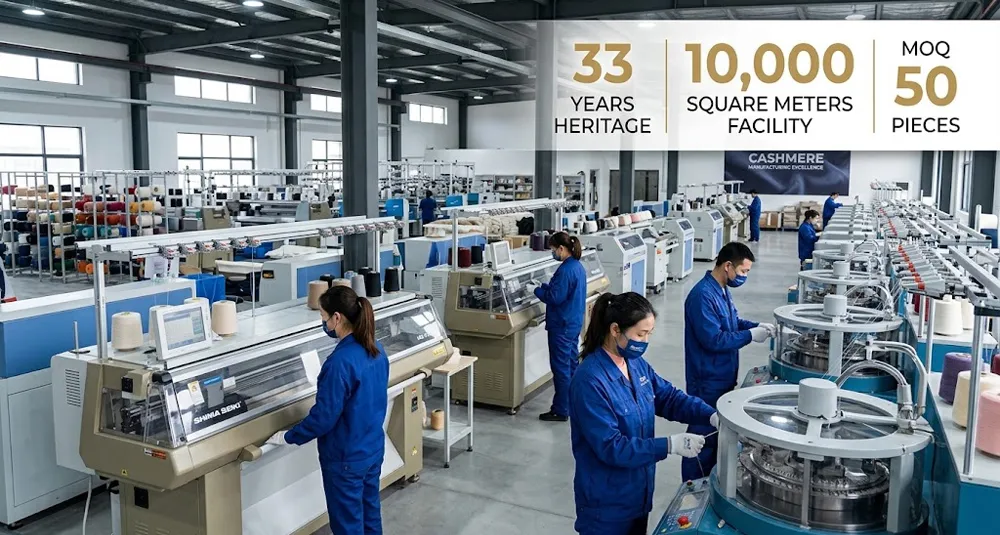
- 33-Year Manufacturing Heritage: Supported by a 10,000 square meter factory production area, over 100 skilled employees, and 80 units of advanced weaving and finishing equipment.
- Flexible Low MOQ Threshold: Supporting boutique labels and scaling retailers with custom orders starting at just 50 pieces per color or style.
- Certified Quality Standards: Utilizing 100% premium Inner Mongolian cashmere and eco-friendly blends fully compliant with CE, SGS, Oeko-Tex Standard 100, and GRS (Global Recycled Standard) certifications.
By combining traditional artisan craftsmanship with automated finishing equipment, Jingshang eliminates common defects like edge fraying while offering flexible order terms. Partnering with a proven factory partner streamlines your sourcing journey from initial design concept through to international delivery.
💡 Frequently Asked Questions
Q: What is the minimum order quantity (MOQ) for custom cashmere scarves at Jingshang?
A: Jingshang offers an industry-leading flexible low MOQ starting at only 50 pieces per color for custom cashmere scarf production, backed by 33 years of expert factory manufacturing.
Partner with Jingshang to elevate your cashmere accessory line with premium Inner Mongolian raw materials, zero-fraying quality control, and low minimum order quantities. Contact our engineering team today to request your free sample and custom quote!
| Inquiry Now | Email:info@hwcashmere.com | Whatsapp:+8613932982033 |
Successfully ordering a custom cashmere scarf batch requires balancing raw material selection, proper structural weaving choices, rigorous sampling, and uncompromising post-production quality checks. By partnering with experienced cashmere scarf manufacturers like Jingshang, B2B buyers gain access to 33 years of technical heritage, flexible 50-piece MOQs, full CE/SGS/Oeko-Tex/GRS certified compliance, and reliable edge-fraying protection. Build your next profitable wholesale cashmere scarf collection with full manufacturing confidence.