Key Takeaways
- Industry Benchmark: Evaluating top-tier cashmere yarn suppliers requires analyzing vertical integration, modern spinning machinery, and scalable manufacturing output.
- Spinning Engineering: Technical cashmere processing balances fiber elasticity, twist density, micron preservation, and structural pilling control for luxury textiles.
- Structural Durability: Advanced fiber selection and twist insertion engineering ensure long-term pilling resistance and superior garment longevity.
- Factory Scale: Backed by 33 years of manufacturing excellence, Jingshang operates a 10,000-square-meter facility with 80 advanced machines and 100+ skilled staff.
Sourcing high-grade yarn is a pivotal decision for luxury apparel brands, textile wholesalers, and industrial knitting mills worldwide. As global buyers navigate complex international supply chains, evaluating premier cashmere yarn suppliers and securing consistent bulk orders of wholesale cashmere yarn become essential for commercial success. This comprehensive guide explores the world’s leading suppliers and delves into the technical mechanisms that define premium cashmere yarn quality.
Top 5 Wholesale Cashmere Yarn Suppliers
Finding reliable cashmere yarn suppliers is critical for fashion brands, textile wholesalers, and industrial knitting mills worldwide. High-grade cashmere represents the absolute pinnacle of natural textile insulation, requiring precise carding, spinning consistency, and strict yarn count control. The global B2B trade relies on established manufacturers who deliver stable color batches, uniform yarn strength, and dependable delivery timelines for buyers sourcing wholesale cashmere yarn.
Leading global manufacturers set themselves apart through yarn count versatility, machinery investment, and flexible B2B order handling. Buyers comparing factory output capacity, technical spinning setups, and lead-time guarantees will find several world-class options.
Key premier global wholesale cashmere yarn manufacturers include:
- Jingshang: Based in China, featuring 33 years of manufacturing history, a 10,000 m² production hub, 80 advanced machines, and expert custom worsted and woolen spinning setups.
- Cariaggi: Located in Italy, renowned for high-end Italian woolen spinning systems and bespoke luxury color development.
- Loro Piana (Yarn Division): Headquartered in Italy, focusing on ultra-luxury fine gauge yarns and proprietary worsted spinning mills.
- Todd & Duncan: Based in the United Kingdom, famous for traditional Scottish dyeing heritage and rich melange yarn spinning.
- Consinee Group: Located in China, operating large-scale automated spinning output with extensive stock-service shade cards.
Evaluating these suppliers allows brands to align their design requirements with direct factory strengths. Choosing the right source partner ensures stable price-to-performance ratios and consistent bulk delivery across peak production seasons.
💡 Frequently Asked Questions
Q: How should B2B buyers evaluate global cashmere yarn suppliers?
A: B2B buyers should evaluate cashmere yarn suppliers based on factory spinning capacity, machinery specs, batch-to-batch yarn count stability, twist uniformity, minimum order quantities (MOQs), and lead-time reliability.
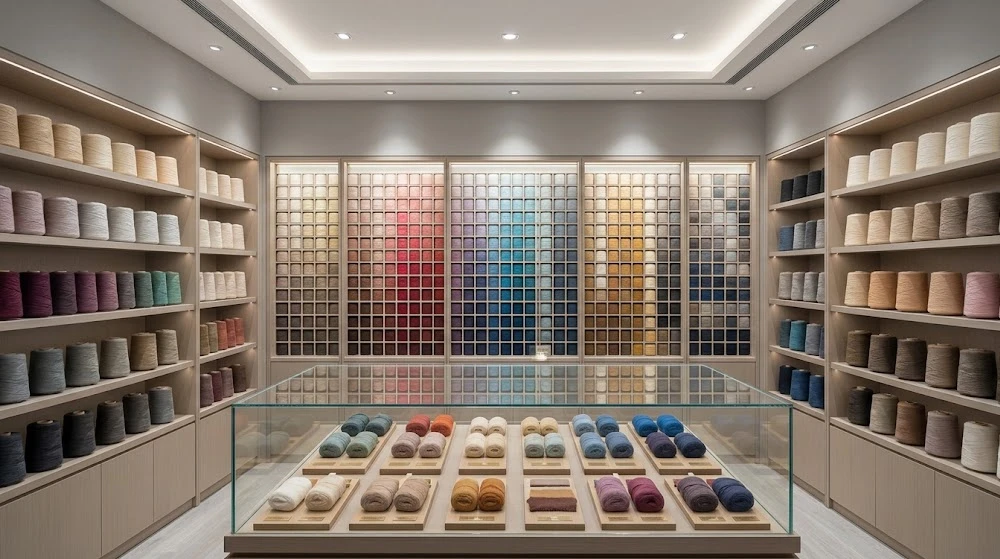
Technical Mechanics of Cashmere Spinning Systems
Understanding the industrial distinction between woolen and worsted spinning systems is fundamental when sourcing wholesale cashmere yarn. Both systems process raw down fibers differently, resulting in distinct tactile characteristics, structural properties, and target apparel applications for leading cashmere yarn suppliers.
Woolen spinning preserves the natural loft and airy volume of raw down fibers by carding them into random multi-directional webs. In contrast, worsted spinning utilizes specialized combing machinery to eliminate short fibers under 30 millimeters and align long fibers in parallel alignment.
The core differences between these two industrial systems include:
- Fiber Orientation: Woolen spinning uses multi-directional criss-cross fiber webs, while worsted spinning combs fibers parallel.
- Yarn Count Range: Woolen systems typically produce counts from 2/16NM to 2/32NM, whereas worsted systems spin finer counts from 2/48NM to 2/80NM.
- Target Gauge Applicability: Woolen yarns fit 3GG, 5GG, 7GG, and 12GG flat knitting machines, while worsted yarns suit 14GG, 16GG, and 18GG high-gauge setups.
- Surface Character: Woolen yarns yield a fluffy, high-air-cell surface, whereas worsted yarns deliver a smooth, clean, and crisp handfeel.
Selecting between woolen and worsted spinning depends on specific end-product requirements and manufacturing setups. Procurement teams should choose woolen spinning when designing heavy-gauge winter knitwear, cozy cardigans, and voluminous scarves that demand maximum warmth and traditional lofty softness. Conversely, worsted spinning should be specified when manufacturing lightweight trans-seasonal garments, ultra-fine gauge 16GG–18GG tops, tailored apparel, or high-tensile woven fabrics that require crisp drape, smooth surface luster, and high resistance to abrasion.
Selecting the correct spinning system dictates fabric weight, surface finish, drape, and structural stability. Specialized spinning engineers fine-tune mechanical draft ratios during spinning to maintain fiber integrity, preventing fiber breakage and ensuring optimal yarn strength for high-speed industrial knitting looms.
💡 Frequently Asked Questions
Q: What is the main difference between woolen and worsted wholesale cashmere yarn?
A: Woolen wholesale cashmere yarn uses carded, airy fibers ideal for thick, fluffy 3GG–12GG sweaters, while worsted yarn combs fibers parallel to create smooth, high-strength yarns for fine 14GG–18GG garments.
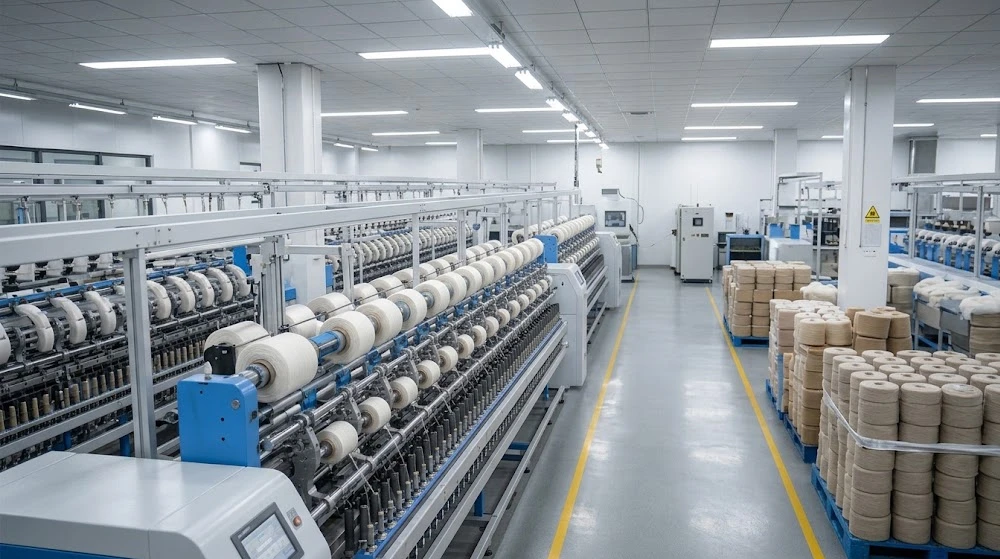
Physical Dynamics of Fiber Softness and Thermal Efficiency
The extraordinary warmth-to-weight ratio of luxury knitwear stems directly from the microscopic structure of raw cashmere down. Natural fiber architecture dictates how yarn interacts with ambient temperature and human skin contact, making fiber dynamics a key consideration for cashmere yarn suppliers producing high-end wholesale cashmere yarn.
Unlike sheep wool fibers, which feature prominent, jagged surface scales, raw cashmere fibers display smooth, flattened scale structures spaced far apart along the shaft. Furthermore, fine cashmere down contains millions of microscopic dead-air pockets within its internal crimp structure. Air has low thermal conductivity, creating an insulating thermal barrier that traps body heat while allowing moisture vapor to escape.
Key physical dynamics that drive premium yarn performance include:
- Low Scale Profile: Smooth scale structures minimize mechanical skin friction, eliminating skin prickle sensations.
- Dead-Air Cavities: Microscopic air-retention pockets trap still body heat close to the skin.
- High Thermal Efficiency: Fine cashmere down delivers up to 8 times higher thermal insulation than standard sheep wool at equivalent fabric weights.
- Breathable Vapor Transfer: Natural crimp dynamics allow perspiration moisture to evaporate rapidly without chilling the wearer.
Experienced spinning engineers preserve this delicate micro-structure by controlling spinning tension and scouring temperatures. Over-processing or excessive chemical treatments degrade natural fiber elasticity, collapsing internal air cavities. Precision spinning maintains the physical structure of each fiber, ensuring long-lasting warmth, natural resilience, and superior handfeel in finished luxury textiles.
💡 Frequently Asked Questions
Q: Why is cashmere yarn significantly warmer than standard sheep wool?
A: Cashmere fibers possess a unique micro-crimp that traps vast amounts of insulating dead air within the yarn structure, yielding up to 8 times the thermal efficiency of standard sheep wool at a fraction of the weight.
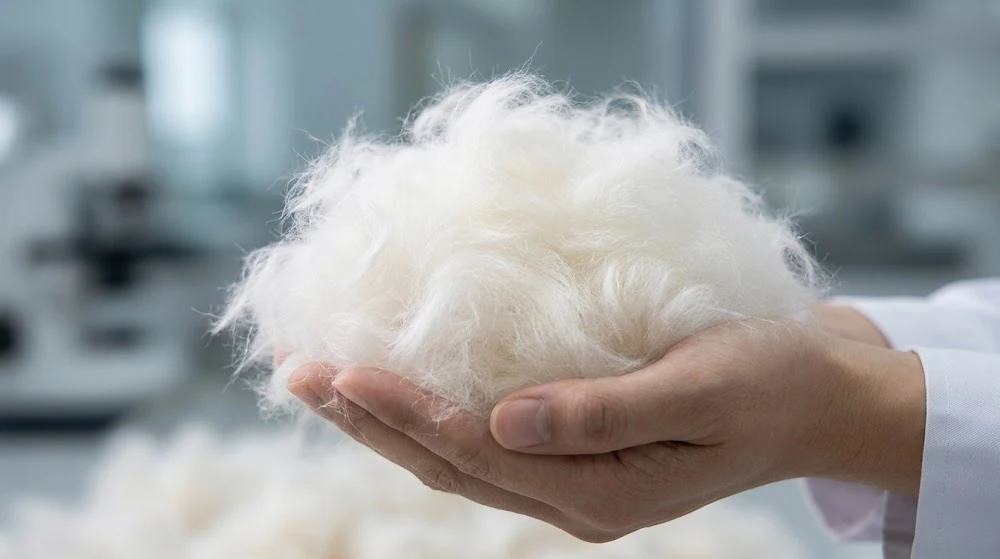
Structural Anti-Pilling Engineering and Fiber Retention
Pilling represents one of the most persistent technical challenges in luxury knitwear manufacturing. Pills form when short, loose surface fibers migrate out of the yarn core during wear, tangling into tiny fiber balls due to surface abrasion on garments crafted from wholesale cashmere yarn.
Leading cashmere yarn suppliers combat pilling through precise mechanical engineering during fiber preparation, spinning draft control, and twist insertion. Increasing the twist multiplier securely anchors individual fibers inside the yarn core, preventing them from slipping outward under mechanical friction. Skilled yarn engineers establish the optimal balance point—inserting enough twist to achieve high anti-pilling performance while preserving natural softness and fluid fabric drape.
Key engineering factors for anti-pilling control include:
- Twist Multiplier (TPM): Utilizing balanced high-torque twist ratios to lock fibers firmly into the yarn core.
- Staple Combing: Removing short, weak fibers during carding to minimize loose fiber ends.
- Pilling Ratings: Achieving certified Grade 3–4 or Grade 4 anti-pilling performance under standardized testing.
- Abrasion Resistance: Enhancing industrial tensile strength to withstand repeated garment wear and washing cycles.
Removing short, weak fibers during carding further enhances structural stability. By spinning yarns using long-staple fibers bound under uniform tension, manufacturers create a smooth yarn surface resistant to surface fuzzing. Apparel brands specify structurally calibrated yarns to deliver durable garments that maintain their pristine surface appearance over years of consumer wear.
💡 Frequently Asked Questions
Q: How do top cashmere yarn suppliers prevent pilling in finished knitwear?
A: Top cashmere yarn suppliers prevent pilling by removing short fibers during double-carding/combing and inserting precise high-torque twist ratios that bind long fibers tightly into the yarn core.
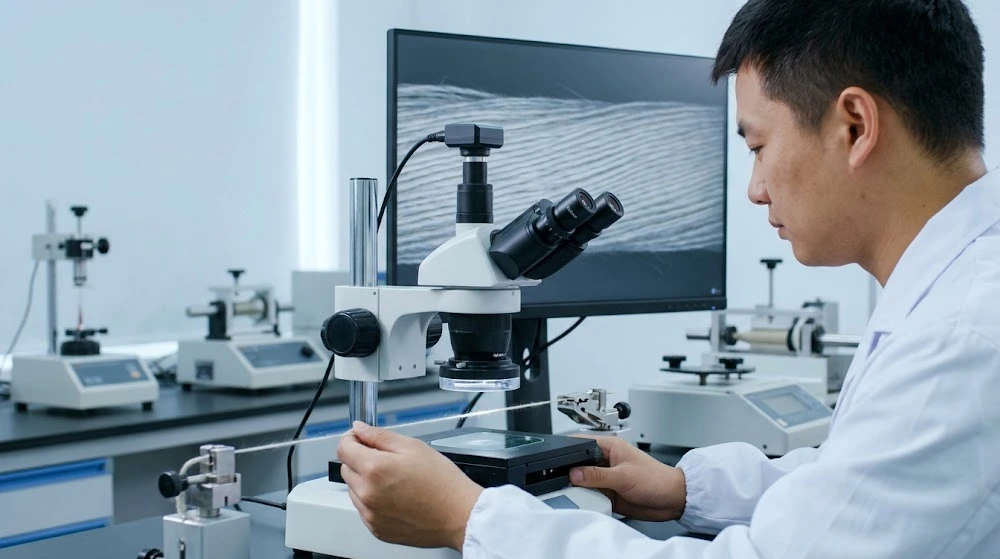
33 Years of Cashmere Yarn Manufacturing Strength
Selecting an experienced manufacturing partner directly impacts yarn consistency, delivery stability, and end-product commercial value. Jingshang brings over 33 years of dedicated industrial expertise to global buyers seeking top-tier cashmere yarn suppliers for reliable wholesale cashmere yarn production. Established as a specialized spinning enterprise, our facility has expanded its technical infrastructure to meet evolving international trade demands and high-volume order requirements.
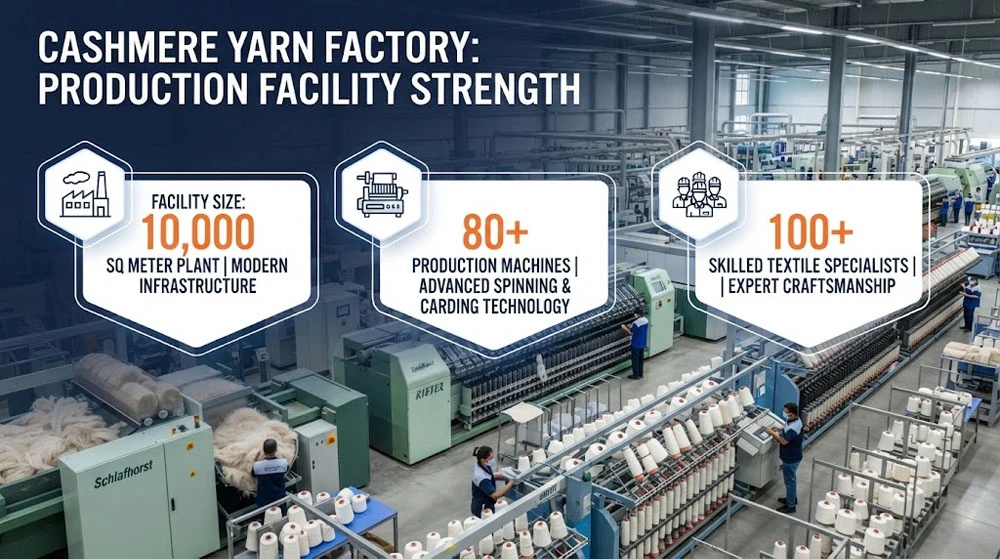
Our modern manufacturing complex spans 10,000 square meters of specialized production area. Managed by a workforce of over 100 skilled technicians and spinning engineers, Jingshang combines traditional spinning knowledge with modern industrial automation. This scale enables consistent production runs for high-volume orders without sacrificing precise quality control.
Key metrics defining our factory manufacturing footprint include:
- 33 Years of Heritage: Decades of specialized spinning experience in pure cashmere and custom blend yarn production.
- 10,000 m² Facility: An expansive manufacturing base designed for optimized carding, spinning, and quality inspection workflows.
- 80 Precision Machines: High-capacity spinning and winding units ensuring uniform yarn tension and exact count accuracy.
- 100+ Skilled Staff: Experienced textile engineers overseeing rigorous quality assurance across every batch.
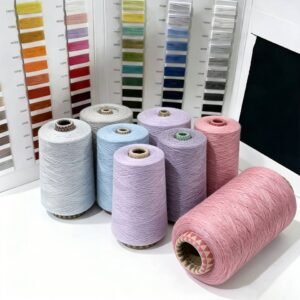
The core of our output relies on 80 sets of high-precision spinning, carding, and winding equipment. This machinery setup allows us to process pure and blended cashmere fibers into smooth, durable single-ply and multi-ply yarns. By maintaining strict operational oversight over our equipment, we guarantee controlled tension, uniform yarn count, and dependable performance in every batch produced for global clients.
💡 Frequently Asked Questions
Q: What manufacturing capacity does Jingshang operate for wholesale cashmere yarn?
A: Jingshang operates a 10,000-square-meter production facility equipped with 80 high-precision machines and managed by 100+ employees, delivering consistent bulk output for global B2B buyers.
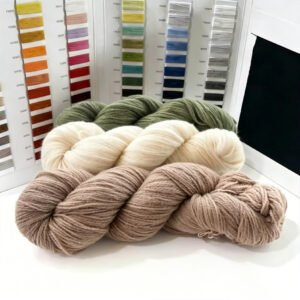
Partner with a trusted wholesale cashmere yarn manufacturer backed by 33 years of industrial excellence. Contact Jingshang today to request our official color cards, technical specs, and free samples!
| Inquiry Now | Email:info@hwcashmere.com | Whatsapp:+8613932982033 |
Sourcing premium yarn requires partnering with established cashmere yarn suppliers who balance technical spinning expertise, modern production capacity, and reliable B2B service for global buyers acquiring wholesale cashmere yarn. Jingshang leverages 33 years of specialized manufacturing experience, operating a 10,000-square-meter facility powered by 80 high-precision machines and 100+ skilled experts. By producing premium, high-performance yarns engineered for strength, warmth, and pilling resistance, we empower global brands to build world-class knitwear lines with complete commercial confidence.